
Darren "Dazbo" Lester
Ask my AI agent anything:
dazbo.co.uk
- Google Chief Technologist at <epam>
- Google Developer Expert (GDE)
- Google Cloud Ambassador

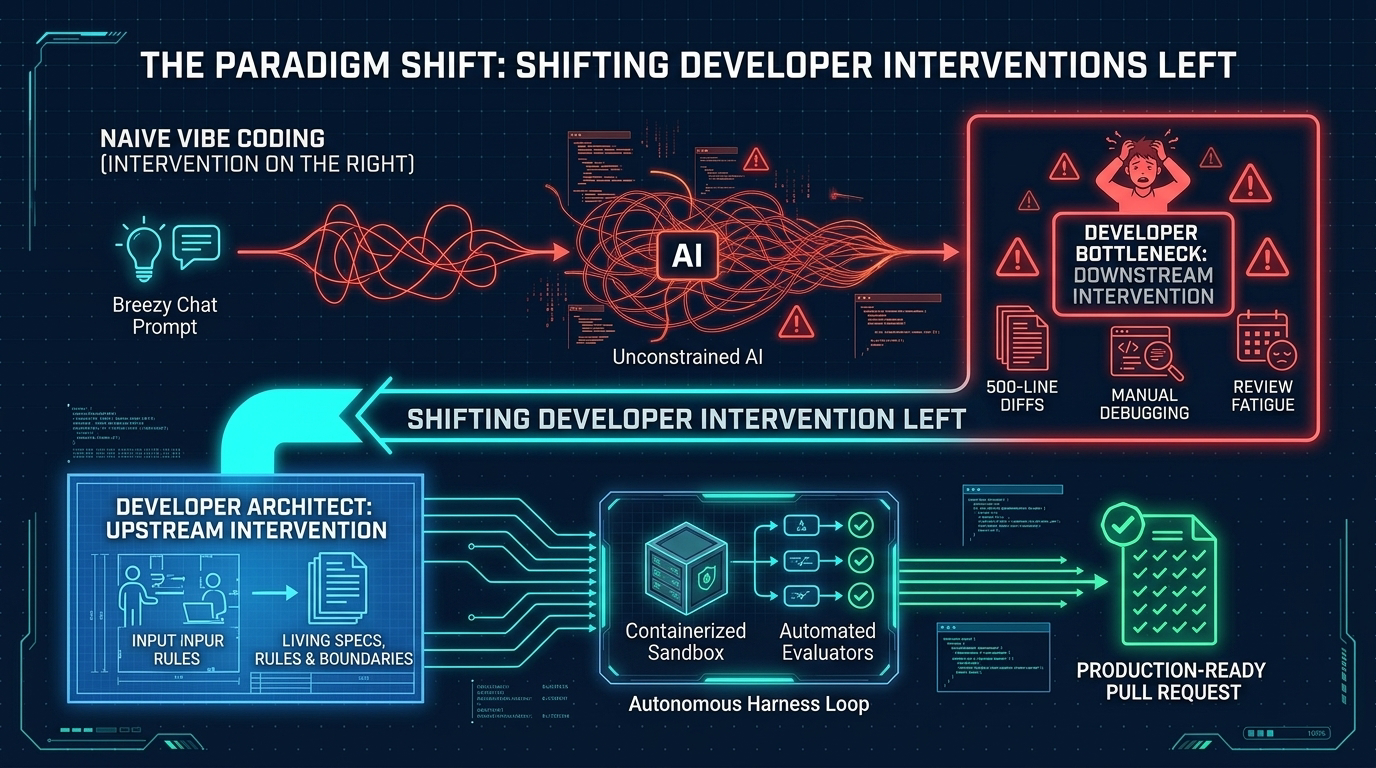
🔴 Vibe Coding: Intervening on the RIGHT (Downstream)
Breezy chat prompt → unconstrained AI dumps 500 lines → human acts as an exhausted manual filter debugging diffs and hallucinations after failure occurs.
🟢 Harness Engineering: Intervening on the LEFT (Upstream)
Engineer the environment before the agent runs: GEMINI.md rules, living specs, container sandboxes, and automated evaluators heal errors inside the loop.
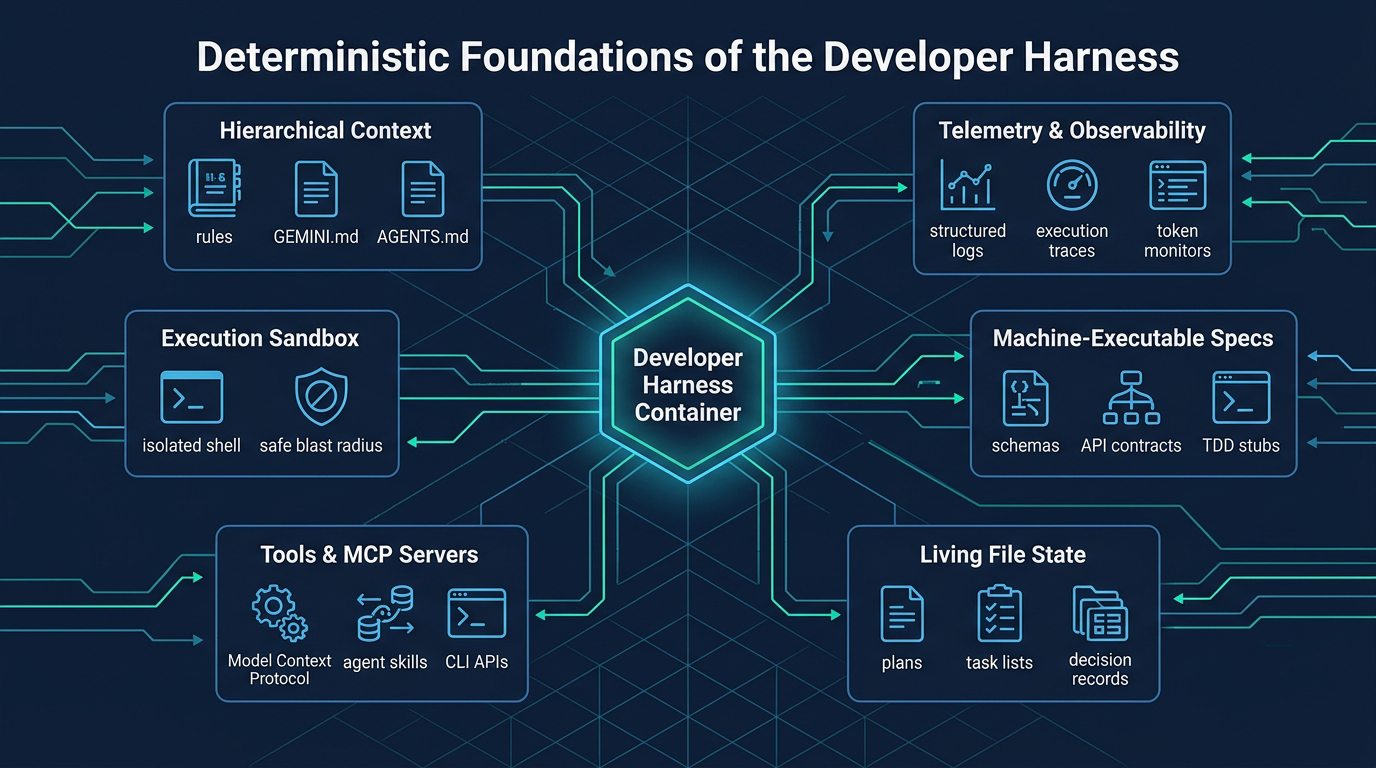
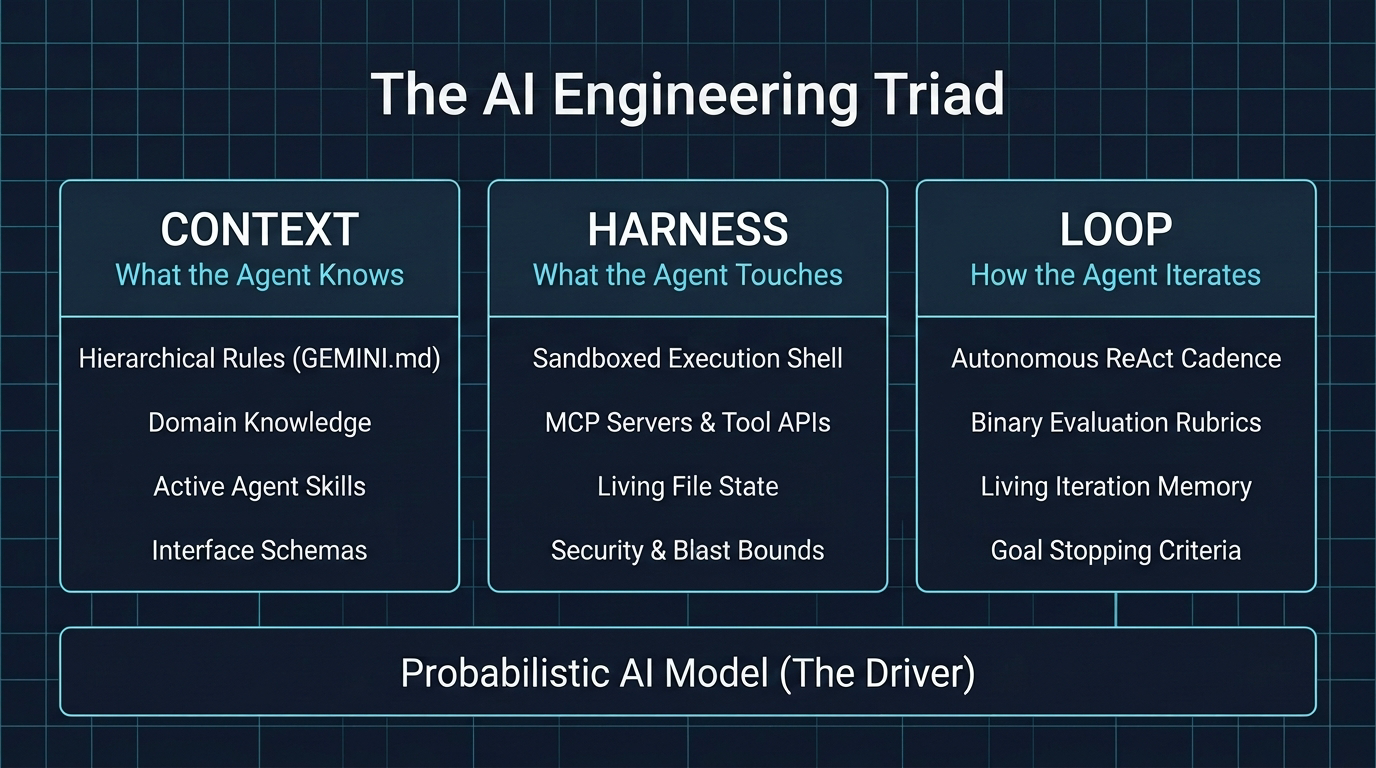
Our Talk Touchpoints
- Hierarchical Context (
GEMINI.md/AGENTS.md) - Tools, MCP Servers & Progressive Skills
- Living State & File Memory (
SPEC.md,plan.md,LIVING_MEMORY.md) - Evaluation Gates & Loop Engine (
RUBRIC.md) - Execution Sandboxing (Blast Radius Control)
- Observability & Trajectory Monitoring
# ~/.gemini/config/skills/loopy/SKILL.md
---
name: loopy
description: Discover, audit, craft, and run repeatable AI-agent
  loops with clear checks and stopping conditions.
---
# Step-by-Step Playbook (Loaded ONLY when triggered!)
1. Inspect target repo & verify deterministic test runner...
2. Set clear stopping conditions (100% pass or max-turn limit)...
Progressive Disclosure = Reduced Context Bloat
- Tool & Skills Sprawl Traps: Connecting 20 MCP servers (150+ schemas) or stuffing 40 guides into
GEMINI.mdburns thousands of tokens every turn and confuses the model. - Progressive Disclosure Levels:
• Level 1 (Metadata): Only the 2-line YAML frontmatter (<100 tokens) loads at startup.
• Level 2 (Instructions): FullSKILL.mdplaybook loads on demand when a matching task begins.
• Level 3 (Resources): Deepscripts/, schemas & templates load only when needed.
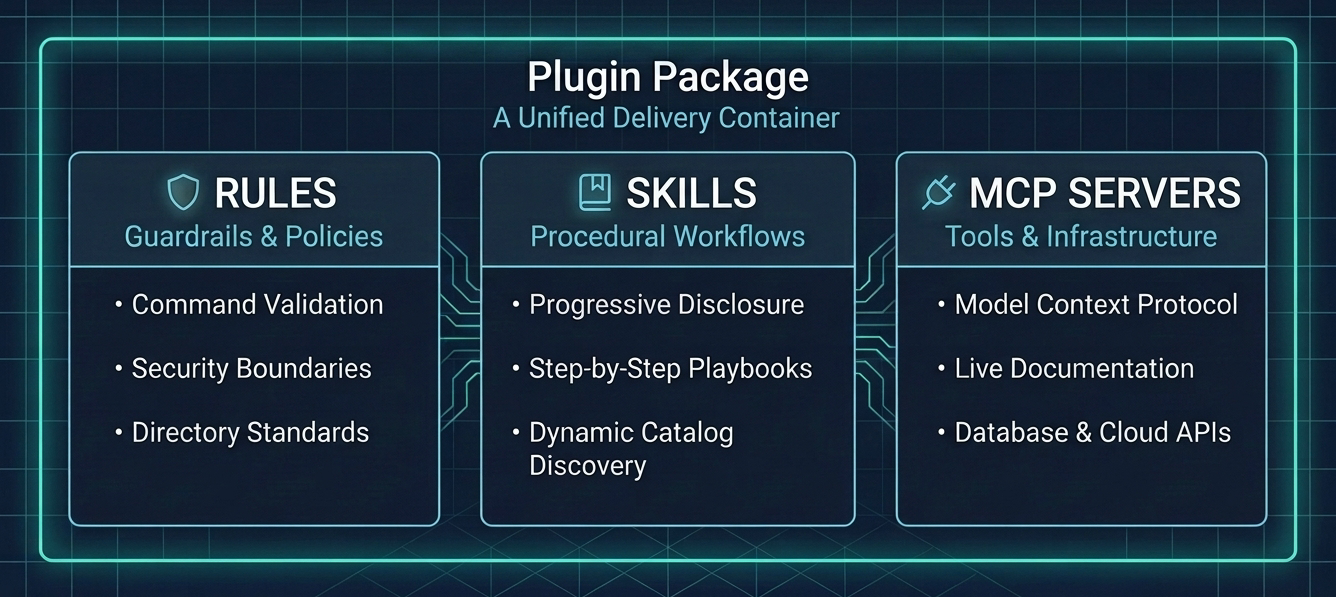
Plugins & My Curated Production Toolkit
- Plugins = Packaging Vehicle: Not a separate harness component — a distribution bundle uniting Rules + MCP Servers + Agent Skills (e.g.
google-cloud-developerwith livedeveloper-knowledgeMCP). - Core Production Skills:
code-review-and-quality,Google Agents CLI (ADK),agent-platform-eval-flywheel,find-skills/organise-agent-skills,maintaining-core-documentation,spec-driven-development&loopy.
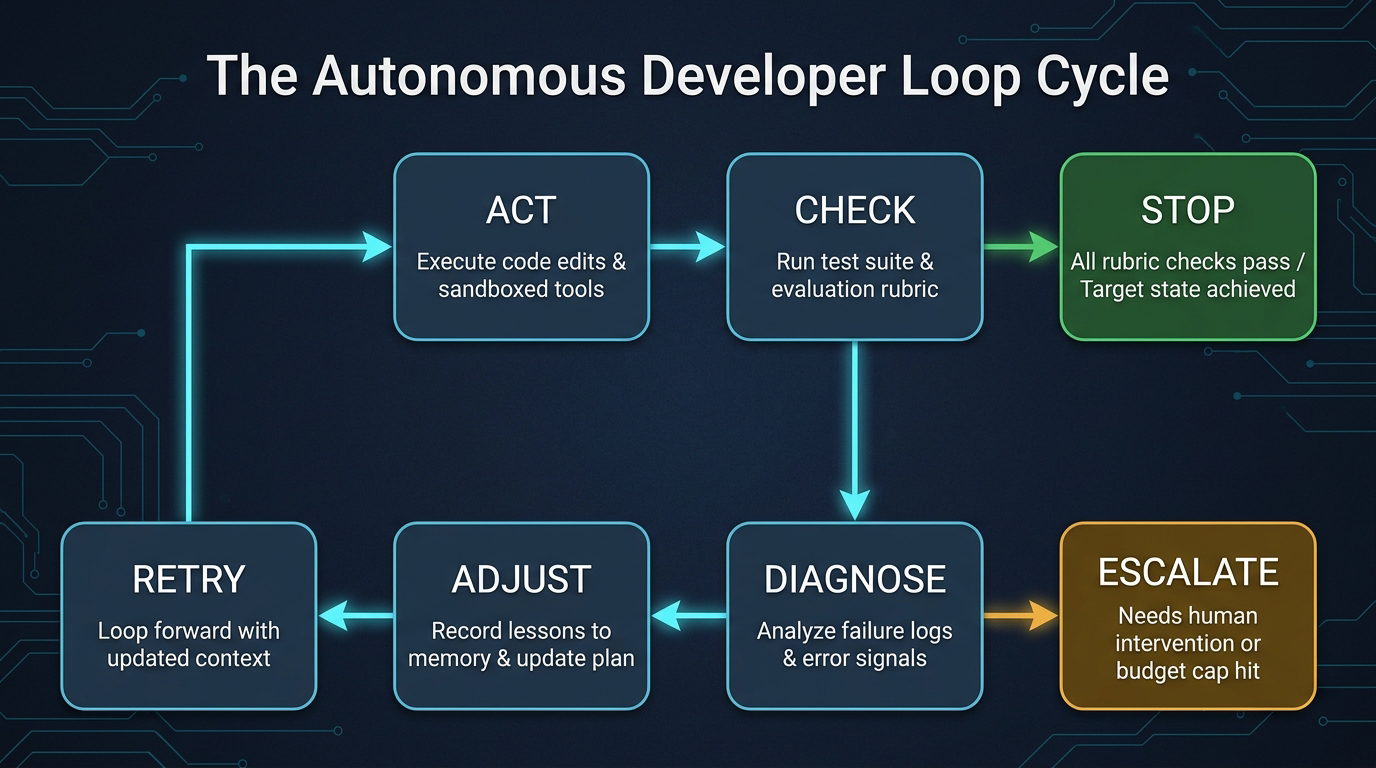
The Closed-Loop Cadence
- 1. ACT → 2. CHECK → 3. DIAGNOSE → 4. ADJUST → 5. RETRY or STOP/ESCALATE: Converge autonomously to 100% pass, or trip a circuit breaker.
- Human-in-the-Loop ≠ Human-in-Every-Turn: Replace continuous babysitting with strategic governance at predefined escalation points.
- Dev Workbench vs Runtime (Spec Spend vs Run Spend): The loop is your development-time forge — not a self-modifying
whileloop shipped into customer-facing production.
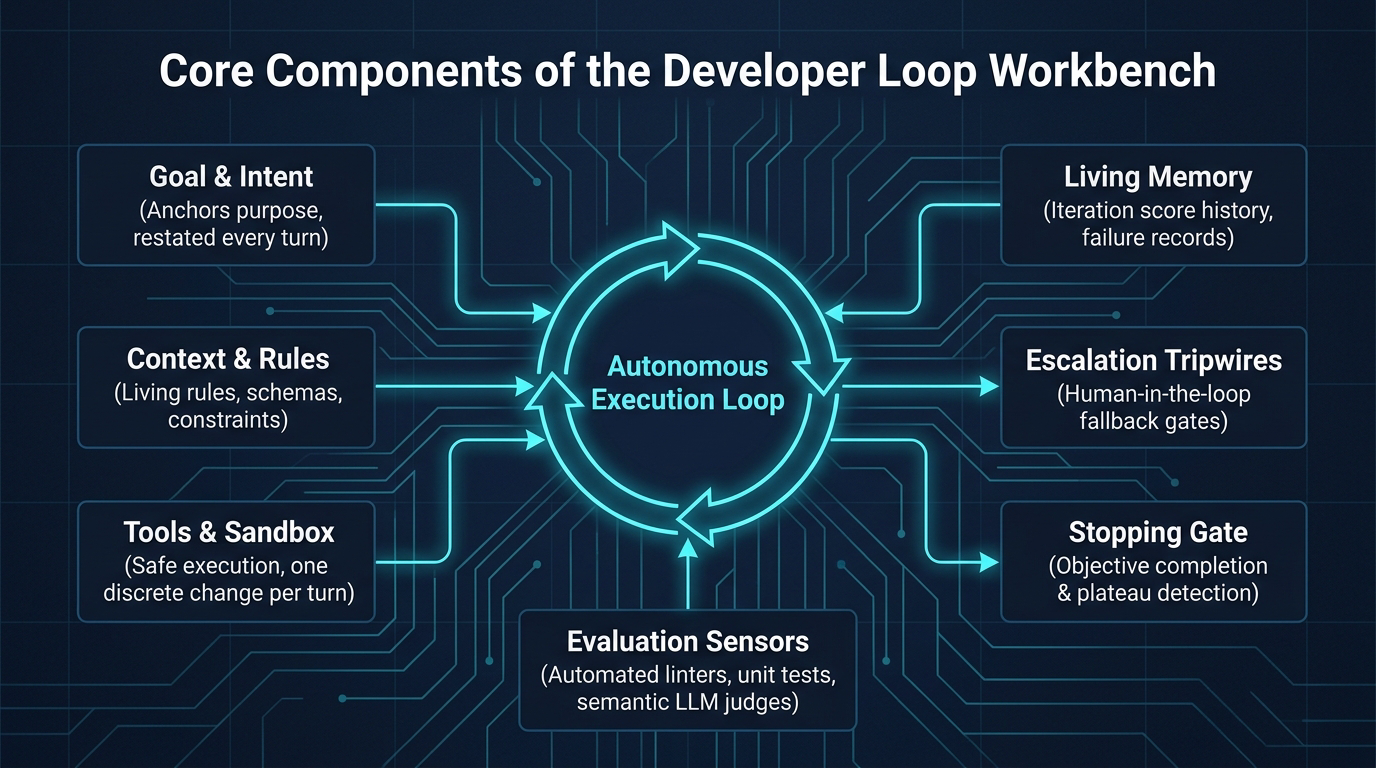
Core Loop Building Blocks
- Context & Goal — Strictly Decoupled:
Context (GEMINI.md+ Skills) = reusable "how we build".
Goal (spec.md) = specific "what we build today", restated every turn. - Sandboxed Tools & TDD + Evals: Safe file/test runners + failing unit tests written first + deterministic linters + semantic Critic forming our Rubric (preventing The Premature Exit).
- Structured Iteration Memory (
LIVING_MEMORY.md): Saving score deltas, root causes, and "Do NOT Repeat" notes after each turn. - Iteration Discipline (The One-Change Rule): Modify one semantic behaviour at a time to isolate regressions (while batching mechanical lint/typo fixes in one pass).
- Escalation Protocol & Stopping Conditions:
✓ 100% Rubric Pass • 🛑 Max Turn Limit (e.g. 5 turns) • ⚠️ Escalate to Human if Score Plateaus or Hits Protected Boundaries
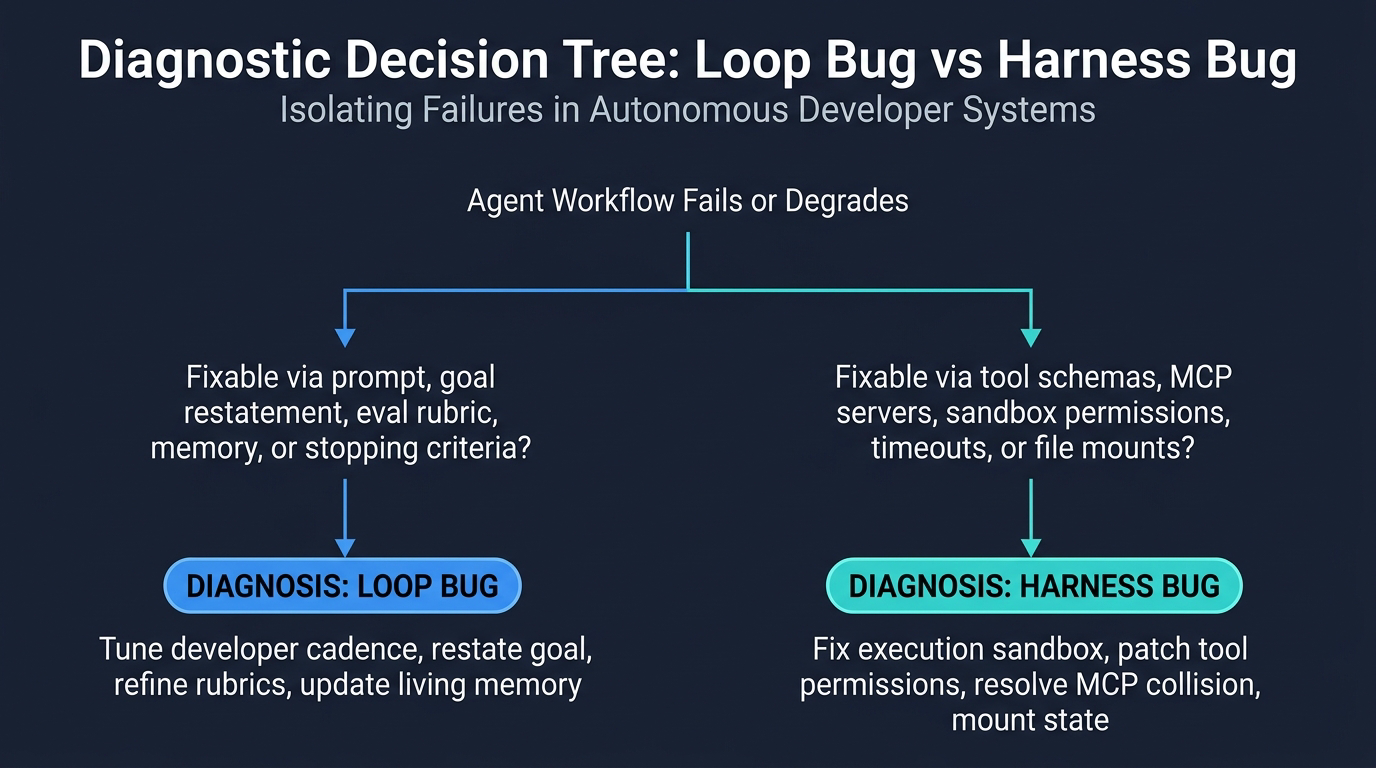
Loop Bug vs Harness Bug Litmus Test
- Loop Bug (Refine the Loop): Fixed by sharpening the goal, refining the prompt, updating
RUBRIC.mdchecks, or adjusting the stopping condition. - Harness Bug (Upgrade the Harness): Fixed by changing tool definitions, adjusting sandbox permissions, modifying timeouts, adding a
SKILL.md/GEMINI.mdrule, or intercepting runtime errors. - Permanent Immunity (The Ratchet): Once encoded into the harness, that entire class of failure is extinct across all future sessions.
Why Our Race Car Needs High-Octane Fuel
- We've locked down HOW we build in
GEMINI.md, MCPs, Skills, and TDD rubrics. - But if you feed a vague 2-line prompt into that harness, you still get slop — just well-linted, type-checked slop that builds the wrong thing!
- We need a persistent specification defining WHAT we build.
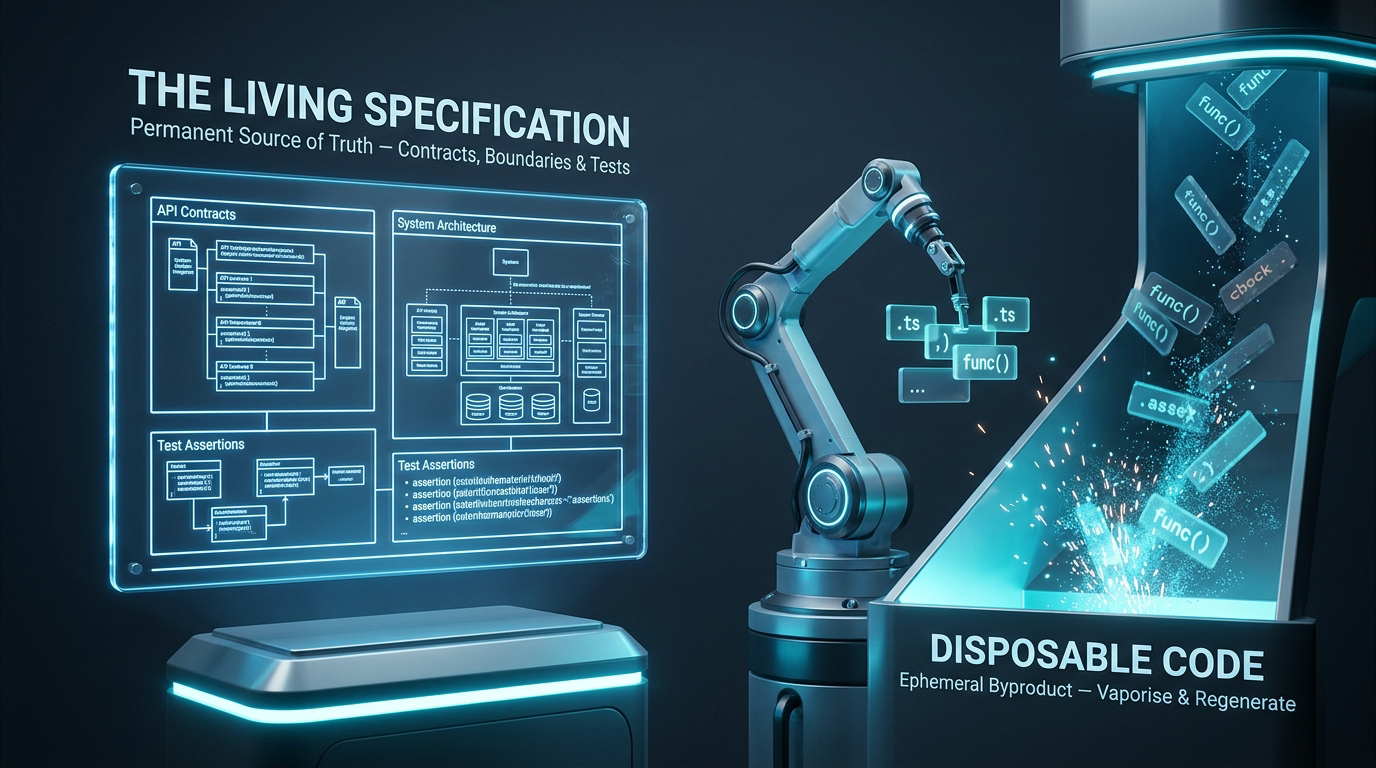
🔥 Controversial Message: Code is Disposable
- Code Is No Longer What We Care About: Your harnessed agent can spit out verified implementation code in 90 seconds, over and over again.
- Specifications Are the Permanent Source of Truth: When requirements change, don't untangle code — update the spec and regenerate!
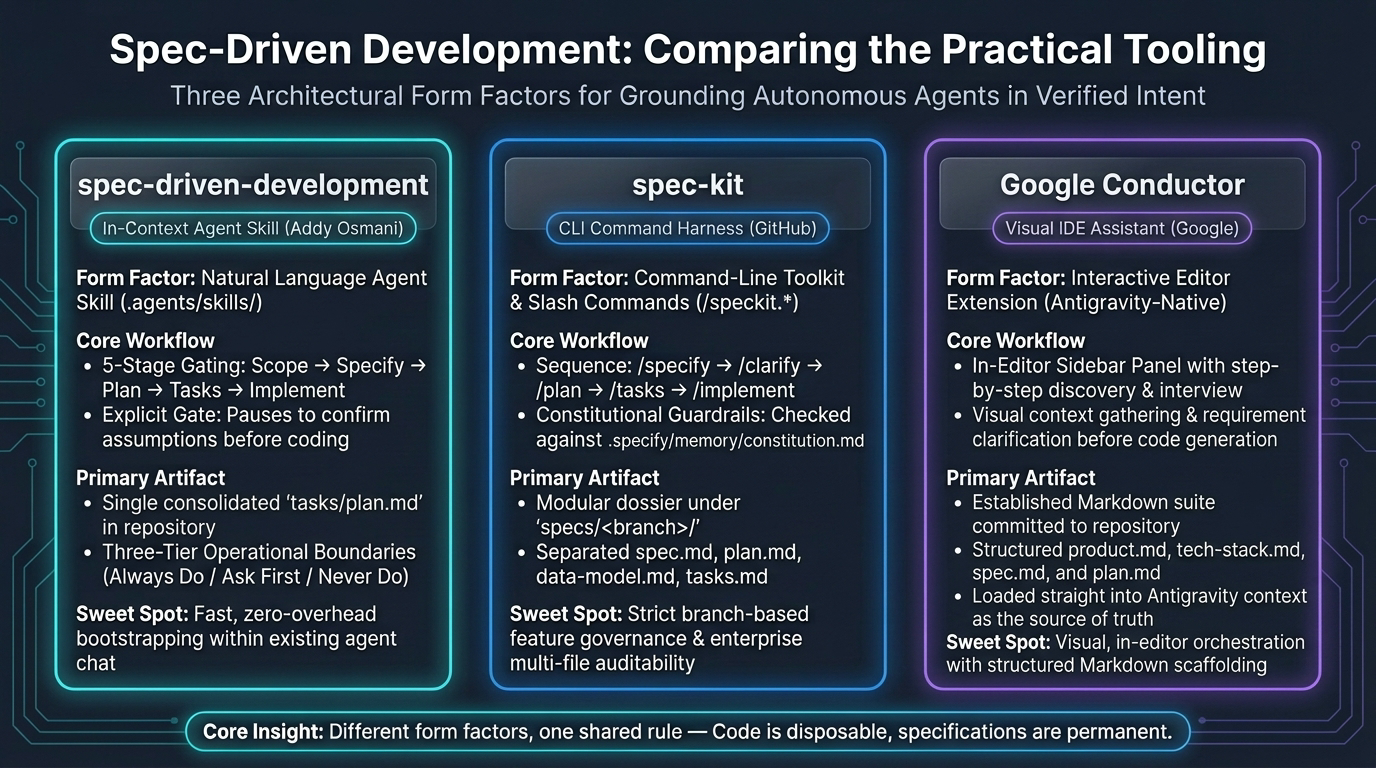
1. spec-driven-development Skill ↗
By Addy Osmani. Conversational gate (Scope Check → Specify → Plan → Tasks → Implement). Pauses to surface explicit "ASSUMPTIONS I'M MAKING" and outputs tasks/plan.md.
2. GitHub spec-kit ↗
CLI & slash workflow (/speckit.specify → .clarify → .plan → .tasks → .implement) governed by .specify/memory/constitution.md, plus lightweight Bug Fixing & Idea Assessment workflows.
3. Google Conductor Extension ↗
Now natively integrated in Google Antigravity! Interviews you in the IDE sidebar to maintain product.md, tech-stack.md, spec.md, and plan.md before unlocking code gen.
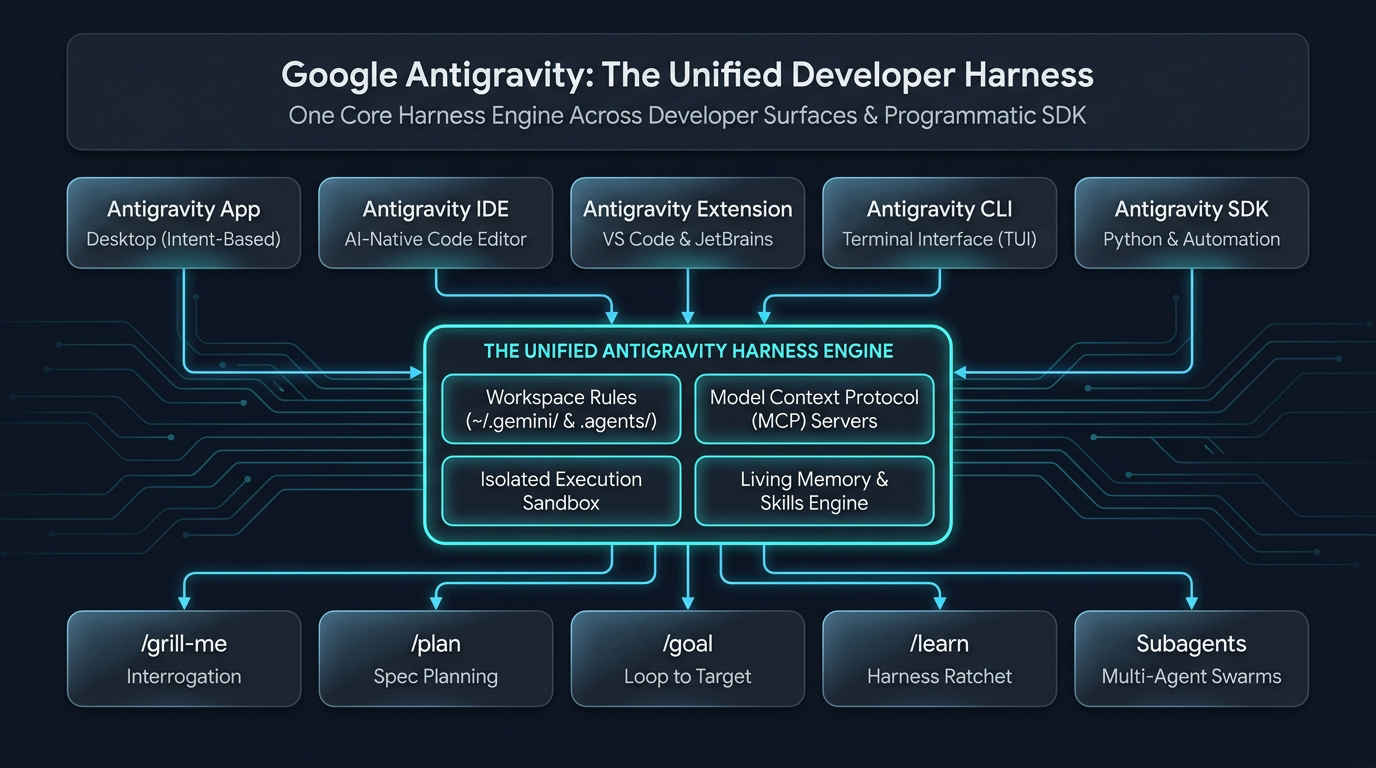
What Antigravity Coordinates Out of the Box
Developer Surfaces + SDK: Antigravity App • Antigravity IDE • IDE Extension (VS Code, JetBrains, Visual Studio, Zed) • Antigravity CLI • Python SDK.
Built-In Plumbing: Auto-binds GEMINI.md, progressive Skills, MCP, container sandboxes, and isolated Subagents.
Combining Formal SDD on Disk + Interactive Slash Commands
- 1. Draft Persistent Spec on Disk (Formal SDD): Native
/plan&/goalalone are ephemeral in chat — use Conductor,spec-kit, orspec-driven-developmentto committasks/plan.mdto Git. - 2. Stress-Test the Spec (
/grill-me): Run/grill-meagainsttasks/plan.mdas a sceptical peer reviewer to expose edge cases before writing code. - 3. Tactical Slice Execution (
/plan+/goal+/boost): Feed one slice fromtasks/plan.mdinto/goal(with/planfor file edits and/boostfor adversarial Builder/Critic review). - 4. Harden the Harness (
/learn): Crystallise runtime discoveries into.agents/rules/orGEMINI.md!

LLM: "Why yes, Dazbo! So hunky!"
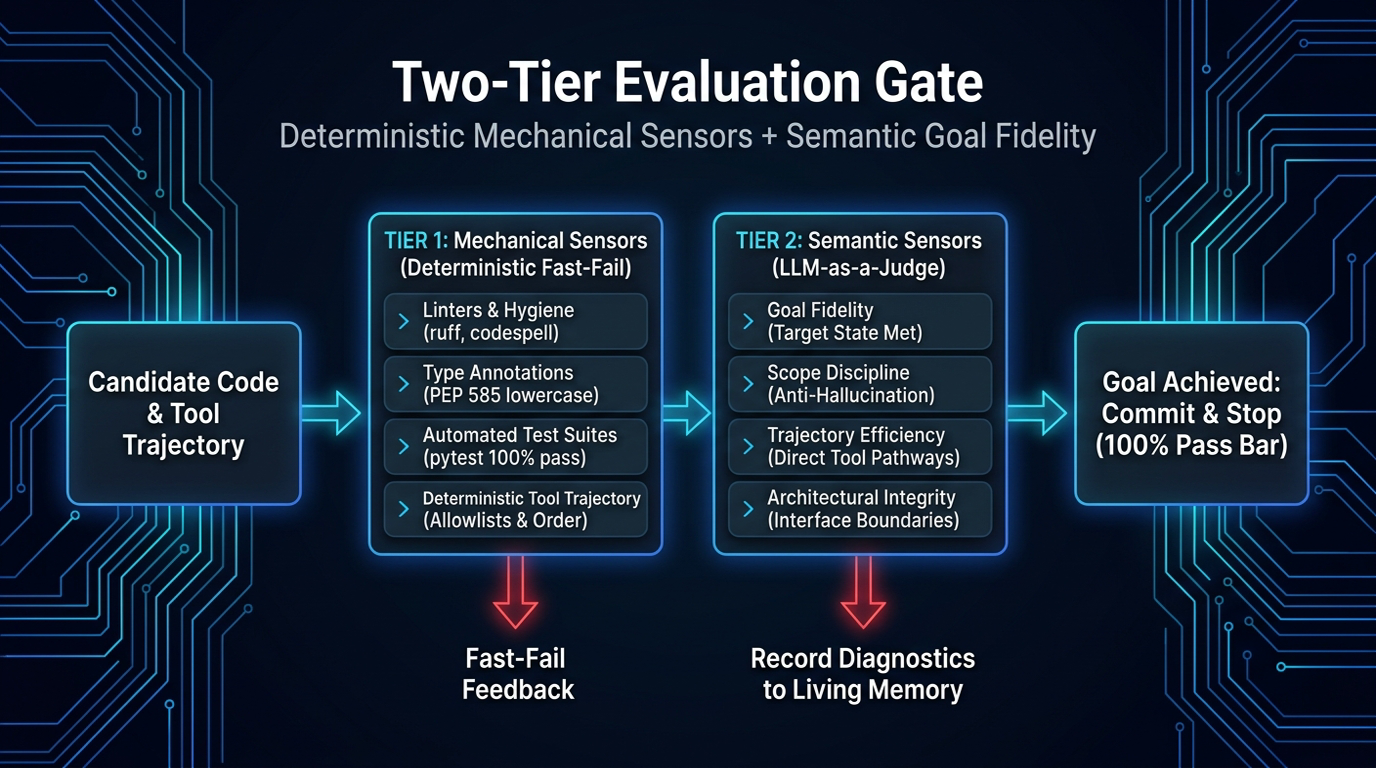
0 / 1 binary assertion graded by an independent, clean-slate Critic agent.
| Category | Strict Binary Assertion (1 = Pass, 0 = Fail) |
How It's Checked |
|---|---|---|
| Deterministic | All unit tests in tests/ pass (100%) AND ruff / codespell report zero errors? |
pytest, ruff & codespell |
| Deterministic | Built-in type hints used AND zero eval(), exec(), or unparameterised queries? |
Static Code Scanner (ruff / bandit) |
| Deterministic | Deterministic Tool Trajectory: Only allowlisted tools invoked with valid schemas? | Agent Tool Execution Trace |
| Deterministic | Live API & UI Wiring: FastAPI starts cleanly & frontend buttons call real /api/game/* endpoints? |
FastAPI TestClient & HTML Check |
| Semantic Critic | Goal Fidelity, Scope Discipline & Clean Architecture: Delivers spec capabilities, zero hallucinated files, and direct tool pathways (no convoluted detours)? | Independent Critic Agent (LLM Judge) |
| Semantic Critic | Remediation Clarity, Design Intent & UX Ergonomics: Actionable error messages, sound design rationale, and responsive interactive gameplay? | Independent Critic Agent (LLM Judge) |
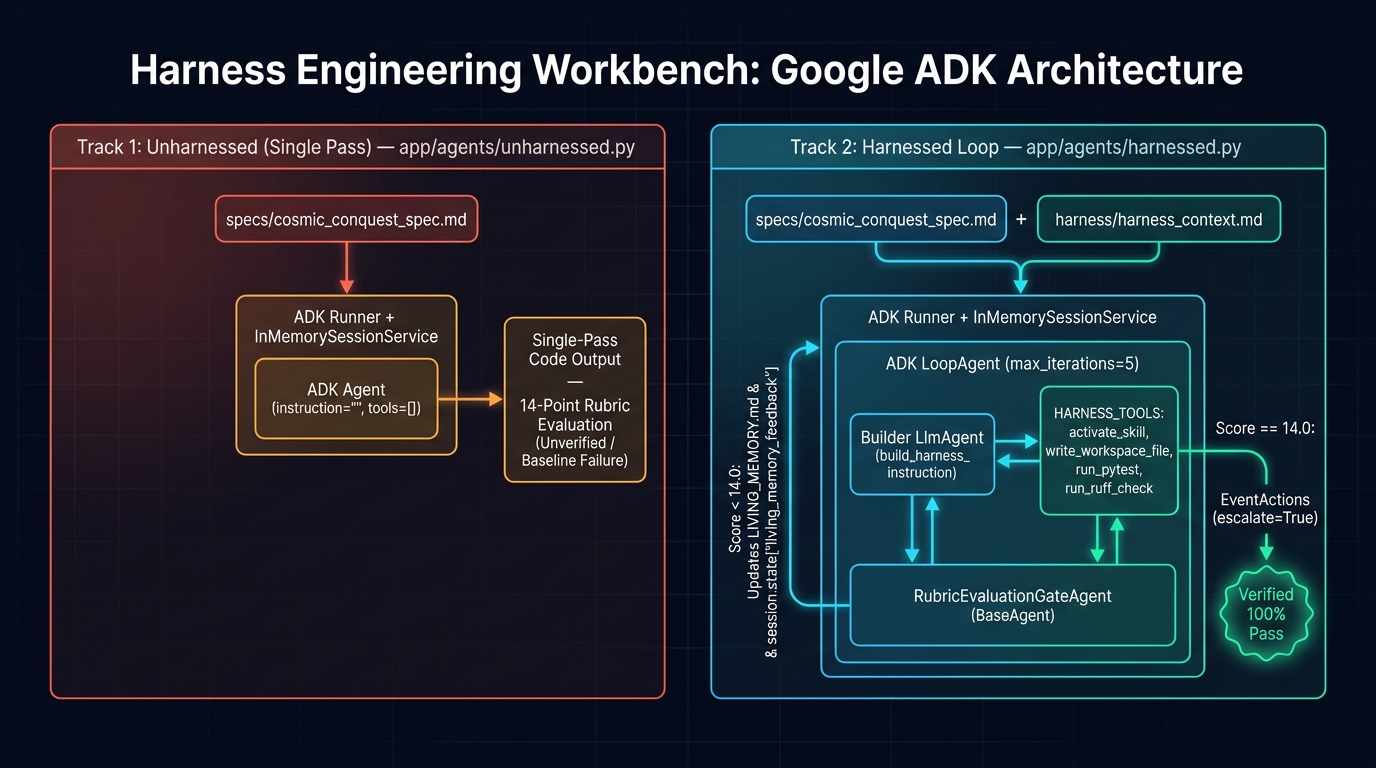
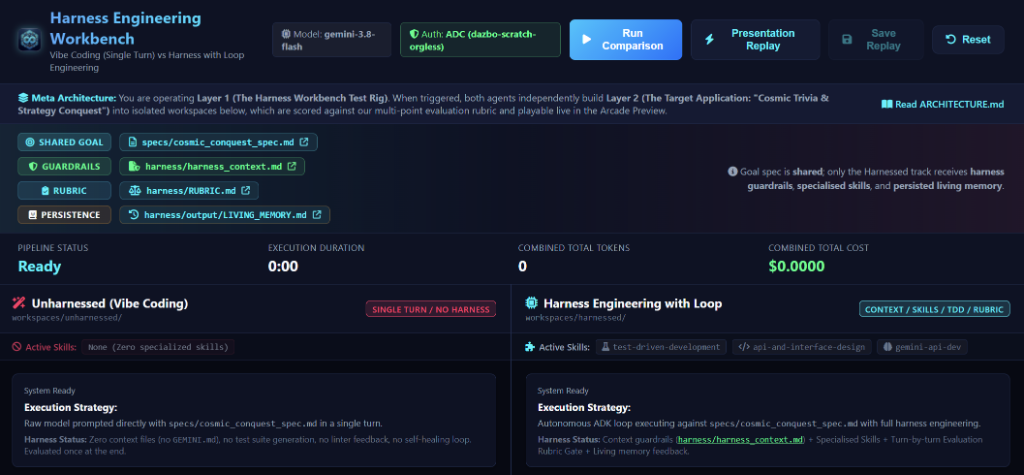
What Both Tracks Are Building: Cosmic Conquest
- Same Spec (
cosmic_conquest_spec.md): Full-stack FastAPI backend + directed sector graph + turn-based combat + interactive browser star map. - Left Track (Unharnessed Vibe): Bare ADK
Agent— single pass, noharness_context.md, no skills, no loop. - Right Track (Harnessed Loop): ADK
LoopAgent(harnessed_builder_agent+RubricEvaluationGateAgent) + 3 Skills (api-and-interface-design,gemini-api-dev,test-driven-development) +LIVING_MEMORY.md+ 14-point binary rubric.
| Metric | Unharnessed (Vibe) | Harnessed (Spec + Loop) | Harness Advantage |
|---|---|---|---|
| Execution Time | 90–120+ seconds | 23–35 seconds | 3–4x Faster |
| Combined Tokens | 18,000–45,000 (~16k out) | ~6,700 (~1,000 out) | ~80% Fewer (~15x less out) |
| Estimated API Cost | ~$0.010–$0.017 | ~$0.0014–$0.0015 | ~85% Cheaper (7–8x less) |
| 14-Point Rubric | 6–11 / 14 (Always fails) | 14 / 14 (100% pass) | Deterministic Quality |
| Functional Game? | ❌ Broken / Dead UI | ✅ Playable & Verified | Only Harnessed Works! |
How Can a Multi-Turn Loop Be Faster & Cheaper Than 1 Prompt?
1. Output Discipline (code to disk, 150-word chat summary → 15x fewer output tokens) •
2. Externalised Reasoning (ThinkingLevel.LOW + millisecond pytest/ruff checks) •
3. Context Pruning (passing only LIVING_MEMORY.md between turns).

1. Why Single-Thread Chat Loops Fail
- Runaway Context Bloat: Every failed draft and 200-line stack trace stays in the chat history.
- Going in Circles: By Turn 4, the model retries a fix that failed on Turn 1 because the error is buried in noise.
- Broken Edits & Drift: Confuses old code drafts in chat with the actual files on disk.

2. Fresh Context per Pass (Clean Subagents)
- Clean Slate Every Turn: Delegate each loop pass to a fresh subagent with a clean context window.
- Receives Only 3 Things:
1. The Target Spec Slice (PLAN.md)
2. Current Workspace Files on Disk
3. The CompactLIVING_MEMORY.mdReceipt - Subagent edits, runs tests, writes receipt, and finishes!
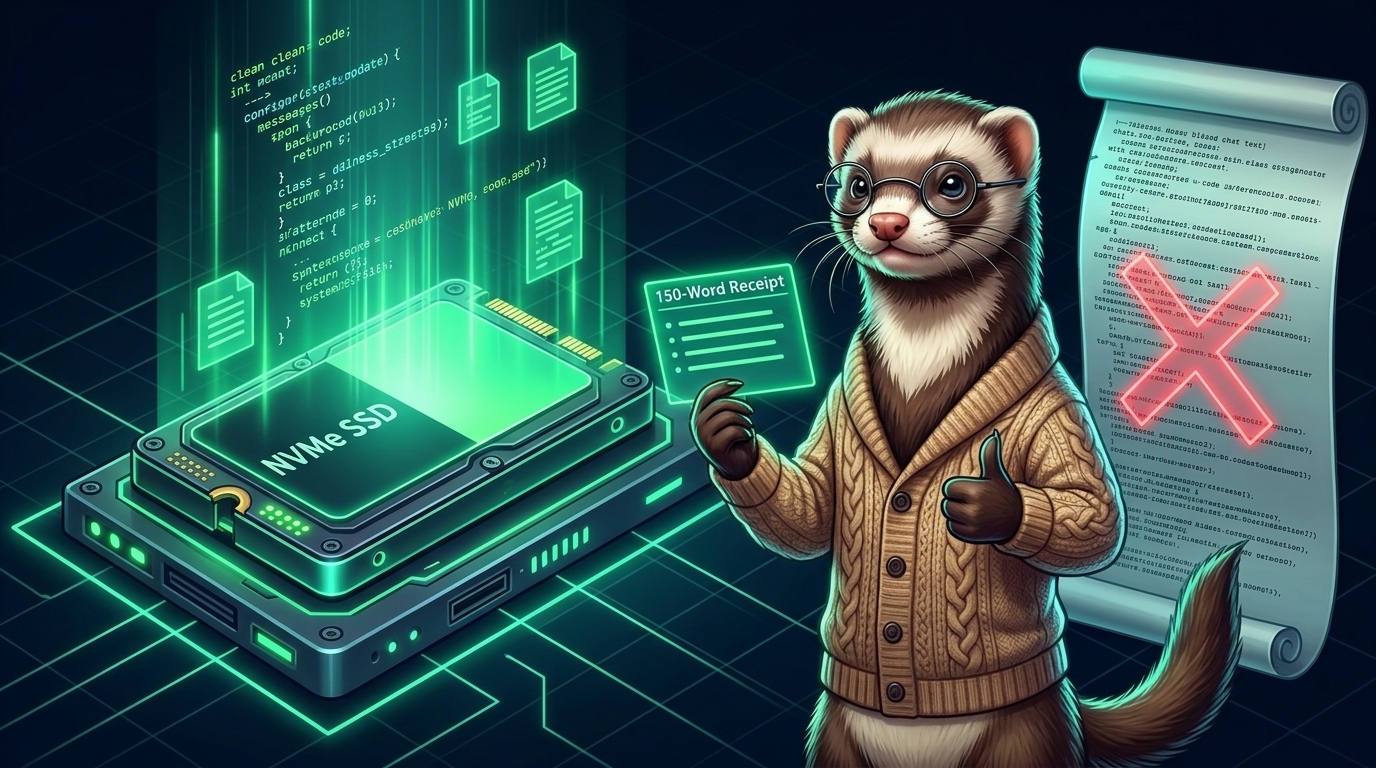
3. Strict Output Discipline (~15–20x Token Reduction)
- Output Tokens Drive Latency & Cost: They are the biggest driver of both how long a loop takes and how much it costs!
- Keep Code in Files, Not Chat: Write code directly to disk via tools; ban full-file dumps in chat replies.
- 150–250 Word Turn Summary: Reply only with what was tackled, root cause of any failure, and files updated.
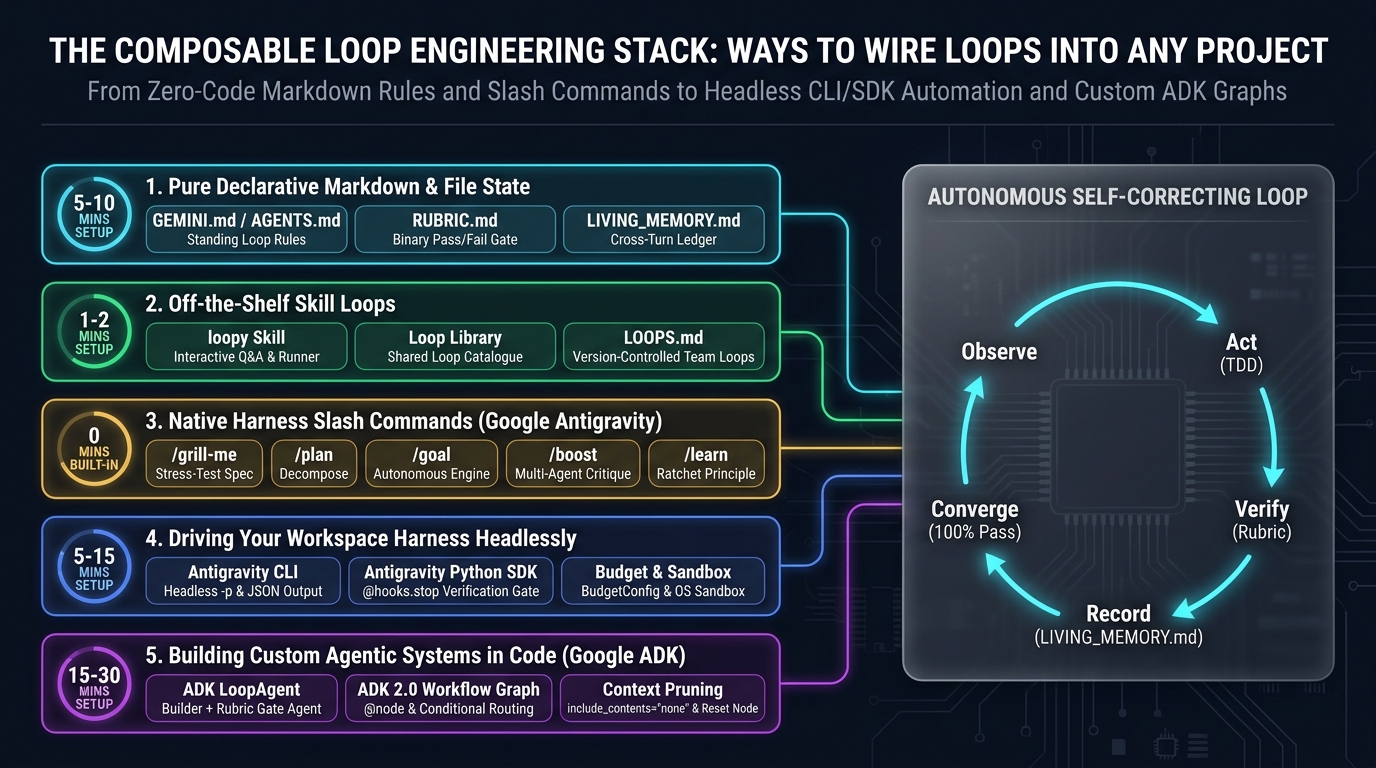
| Mechanism | What It Supplies | Setup Time |
|---|---|---|
| Antigravity Slash Commands ( /grill-me, /plan, /goal, /boost, /learn) |
Interactive stress-testing, hands-off loop execution, multi-agent critique, and ratcheting. | 0 mins (Built-in) |
Loopy ↗ (loopy skill + LOOPS.md + Loop Library) |
Ready-made or Q&A-crafted loop prompts, verification gates, stop rules, and a shared repo loop catalogue. | 1–2 mins |
| Custom Markdown ( AGENTS.md, RUBRIC.md, LIVING_MEMORY.md) |
Standing engineering rules, binary pass/fail criteria, and persistent cross-turn memory. | 5–10 mins |
| Antigravity CLI & SDK | Headless CI/CD execution (-p, --output-format json), Python @hooks.stop gates, and budget caps using Antigravity's built-in coding harness. |
5–15 mins |
| Google ADK ↗ ( google-adk LoopAgent & Workflow Graphs) |
Custom multi-agent topologies, bespoke evaluation gates, and conditional graph routing. | 15–30 mins |
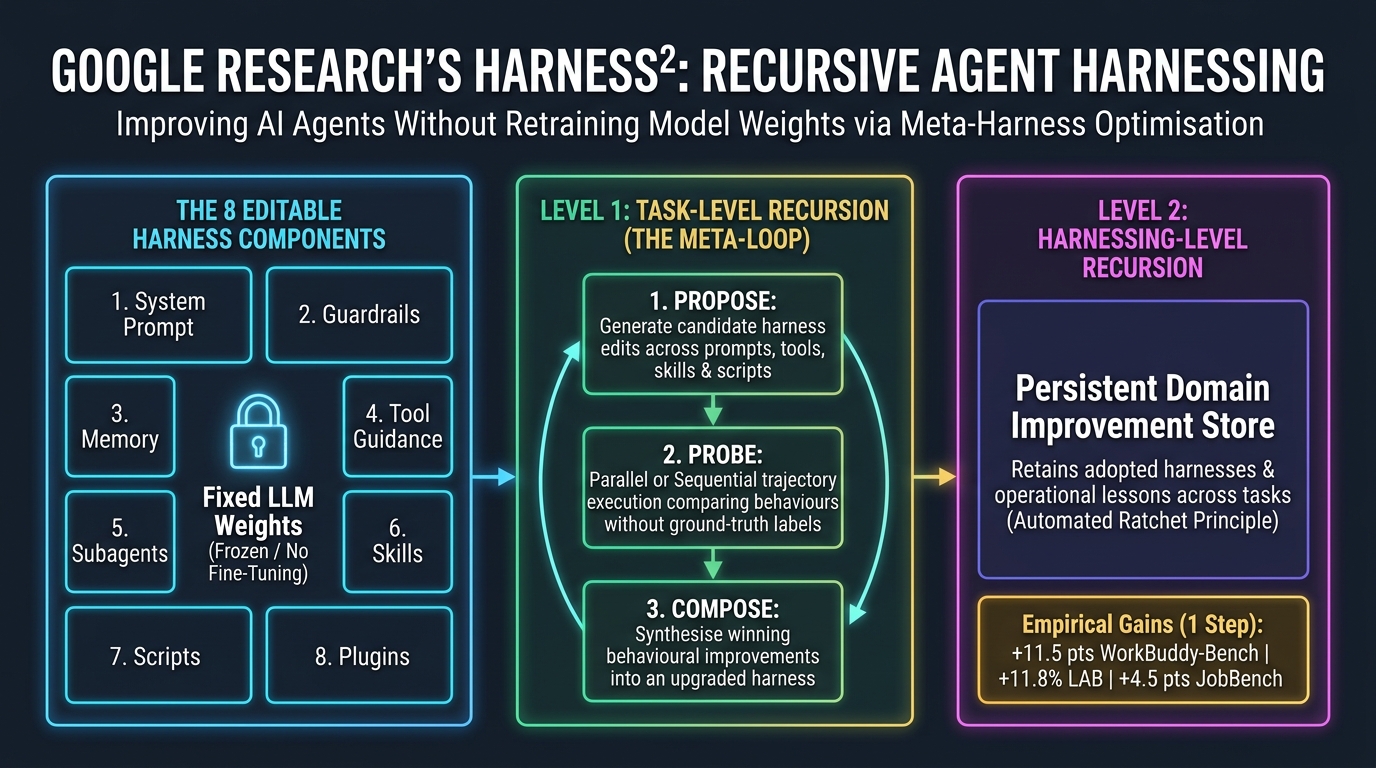
The Outer Meta-Loop Concept (Harness²)
- Keep the Model Fixed, Upgrade the Harness: Instead of only tweaking prompts, an outer meta-loop (
Propose → Probe → Compose) evolves the entire harness:System Prompt,Guardrails,Memory,Tool Guidance,Subagents,Skills,Scripts, andPlugins. - Cross-Task Memory (
EXPERIENCE.md): Keeps the base harness clean while recording operational lessons across tasks so future runs never start from scratch.
How You Implement This Ratchet in 2 Minutes Today
- Step 1 (Inspect): Whenever a loop took >1 turn to pass
RUBRIC.md, inspectLIVING_MEMORY.md. - Step 2 (Log to
EXPERIENCE.md&/learn): RecordCue → Harness Upgrade → Evidencein.agents/experience/EXPERIENCE.md(instead of bloatingGEMINI.md) and update the relevantSKILL.md, script, orRUBRIC.md. - Step 3 (Apply): Apply the harness upgrade so future tasks pass first time.